

From results showing increased participation with PSA home sampling and new publications to insights, into what makes a good self-sampling device — here are some of the latest updates from Capitainer.

🎉Home sampling for PSA increases participation in organized prostate cancer testing
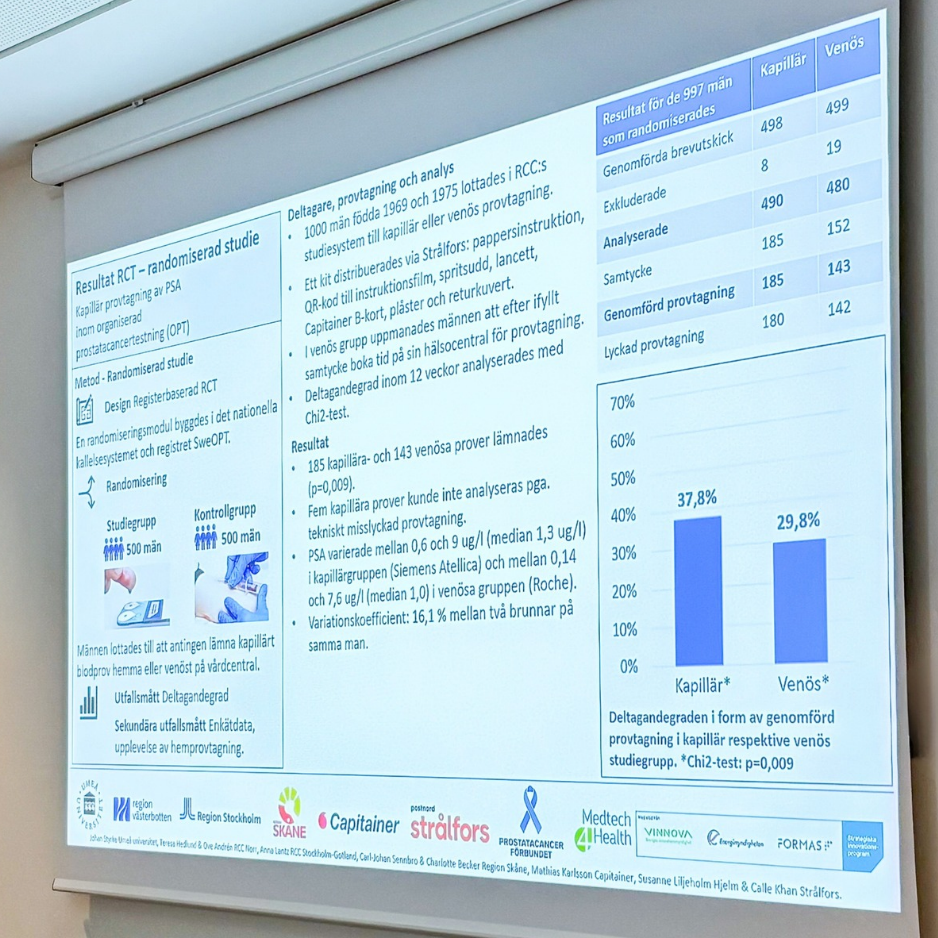
Results presented by Johan Styrke, at Urologiveckan 2026 (the Swedish national urology meeting) in Växjö, show strong and encouraging results for capillary home sampling of PSA within organized prostate cancer testing (OPT) in Sweden.
The study included both a performance evaluation and a randomized controlled trial. Capillary PSA samples collected using Capitainer® showed strong correlation with venous samples (r = 0.985), with a sensitivity of 94% and specificity of 100% at a PSA cut-off of 3.0 µg/L (data awaiting publication).
In the randomized trial, 997 men were offered either capillary home sampling or conventional venous blood sampling at a healthcare center. Participation was significantly higher with home sampling: 37.8% compared with 29.8% for venous sampling (p = 0.009).
The results show that PSA home sampling can provide good analytical performance while offering a way to increase participation in organized prostate cancer testing.
📖 New protocol expands the possibilities of DBS for multi-omics
A new protocol published in STAR Protocols explores how more information can be obtained from a single, small blood sample.
Using Capitainer®B10, the protocol enables both metabolites and lipids to be extracted and analyzed from the same 10 µL dried blood spot – opening up further possibilities for volumetric microsampling in multi-omics research.
Read the protocol here.
🔎Another interesting read: A new approach to PEth analysis
A new study published in Analytical and Bioanalytical Chemistry explores a new approach to PEth analysis using Capitainer®B10 Vanadate.
PEth is a blood-based biomarker used to assess alcohol consumption. In the study, researchers integrated an internal standard directly into the sampling device, allowing it to be present from the moment the blood sample is collected rather than being added later during laboratory processing.
The results showed good repeatability and analytical performance, demonstrating a promising approach for more reliable PEth measurements in clinical and forensic applications.
Read the publication here.
🩸What makes a good self-sampling device?
Self-sampling can make testing more accessible and convenient – but a good self-sampling device needs to deliver more than convenience.
Hear Mikael Ström, Business Development Director at Capitainer, briefly explain microsampling and one key difference between conventional DBS and volumetric microsampling: knowing exactly how much blood has been collected.
In our latest article, we take a closer look at what makes a good self-sampling device, from both the user and laboratory perspectives.
Read the full article here.