

From PFAS to PEth: Exploring Microsampling in Human Biomonitoring
Research Spotlight – Meet Martina Galletto, PhD
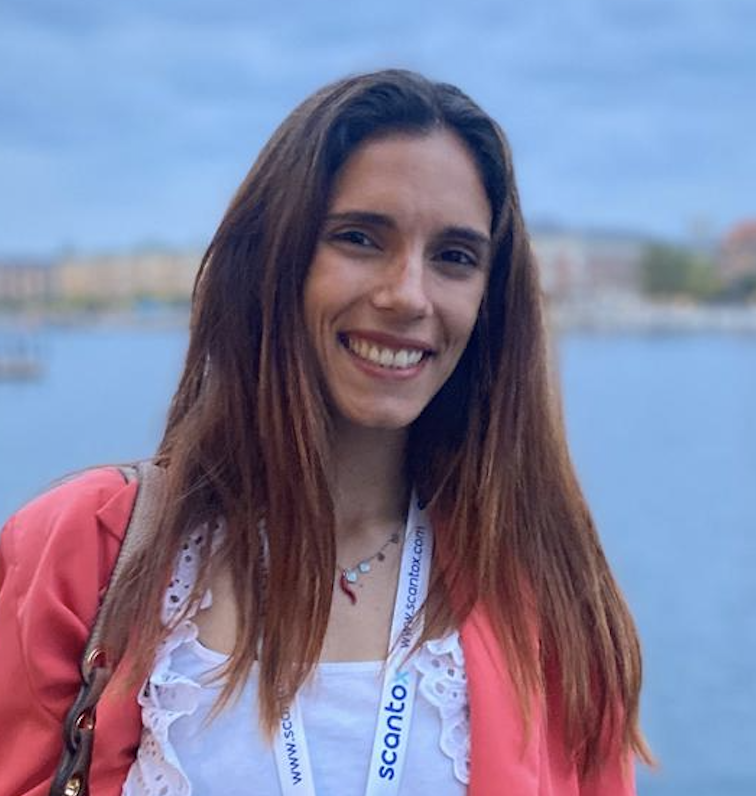
About
I’m Martina Galletto, I’m 27 and I’m originally from Italy. I’m currently a postdoctoral researcher at the University of Copenhagen, in the Department of Nutrition, Exercise and Sports.
The common thread running through all my research is analytical chemistry, and in particular mass spectrometry.
I did my bachelor’s in chemistry at the University of Ferrara, with an experimental thesis on optimizing the synthesis of chiral esters. I then moved to Turin for a master’s in Clinical, Forensic and Antidoping Chemistry. Over those two years I became fascinated by how mass spectrometry is applied in forensic toxicology and clinical settings, and I wanted to build hands-on analytical skills in that field. That’s also how I first came to work with microsampling: my master’s thesis focused on developing and validating a method to detect emerging synthetic opioids, the nitazenes, in volumetric dried blood spots.
It felt like a natural next step to continue in that direction, so I joined the PhD program in Chemical and Materials Sciences at the University of Turin under the supervision of Professor Alberto Salomone and the co-supervision of Professor Laura Anfossi. Over three years, I worked on a thesis entitled “Dried Matrix Spots Microsampling for Analysis of Forensic and Clinical Interest”. During that time, I also spent periods abroad, in Belgium and in the USA, to deepen my technical knowledge and build a genuine network of collaborations.
Looking back, and looking ahead, I would describe myself as an analytical chemist specialized in method development, optimization and validation for human health applications. My particular expertise is in microsampling, which I see as a new frontier for participant-centered approaches in disease prevention and health promotion.
What were the main areas of focus during your PhD research, and what were you hoping to achieve?
My PhD was co-funded by Capitainer, and it was originally meant to focus only on dried blood spots and their potential for analyzing molecules of concern for human health. Over the months, though, the project grew. I started to explore microsampling with other biological matrices, such as plasma, serum and urine.
I also looked for ways to improve the technology itself. Capitainer devices are volumetric, which overcomes the main limitation of classic DBS, the hematocrit effect. I wanted to add one more piece: incorporating a stable isotope-labelled internal standard directly into the filter paper of the card. This avoids any discrepancy between the dried analytes and the internal standard used for quantification and leads to what we call an “internal quantification DBS” card, or iqDBS. I developed this at the University of Florida, in the Department of Pathology, Immunology and Laboratory Medicine, under the supervision of Professor Timothy Garrett. We used the Capitainer B10 Vanadate card to incorporate labelled phosphatidylethanol 16:1/18:0, a long-term alcohol biomarker in whole blood. The goal was a reliable and accurate workflow for clinical contexts such as monitoring compliance in organ transplantation.
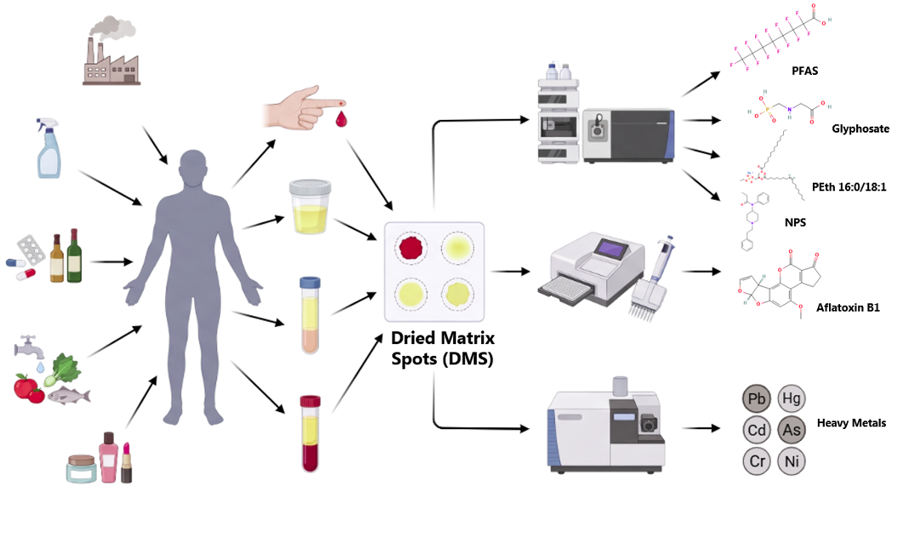
The broader ambition of the project was to build several methods that converge on human biomonitoring, supporting exposome research through self-sampling, which puts the participant, and not the patient, at the center. I divided the exposome into two clusters: the external one, linked to environmental exposure, and the internal one, linked to personal behavior and lifestyle (see Figure below). Both can have a major impact on human health.
For external exposure, I developed three applications. First, the determination of 25 perfluoroalkyl substances, PFAS, in dried blood spots collected with the Capitainer B10 card. Second, the screening of aflatoxin B1 by competitive immunoassay, using extracts from the Capitainer B50 card and from dried serum spots. This last part was carried out at Ghent University, under the supervision of Professor Marthe De Boevre. Third, the quantification of glyphosate and its main metabolite in dried urine collected with the Capitainer DIP70 card, with a focus on occupational settings such as agricultural workers.
To include the nutritional side of exposure, I also explored heavy metals during a period at miQro Lab Solutions in Rhode Island, under the guidance of Dr. Donald Chace. There, we analyzed both toxic metals and essential trace elements by ICP-MS, extending microsampling to plasma with the Capitainer SEP10 card.
Finally, for the internal exposome, I worked on alcohol, with the iqDBS development I mentioned, and on drugs of abuse. In particular, I developed a quantitative method for a panel of 131 new psychoactive substances in dried urine spots.
If you had asked me at the beginning of my PhD what I hoped to achieve, my answer would be the same as today: to help society prevent disease and support human health. People sometimes see academic researchers as working on abstract concepts without real practical impact. My goal as a scientist is the opposite: to give communities practical tools to monitor their health, so that we can better understand toxic exposure and ultimately prevent disease.
Looking back at your research, what findings or achievements are you particularly proud of?
Doing a PhD is like riding a roller coaster, and failure is a normal part of the journey. Some days are spent entirely in the laboratory running experiments, others in front of a computer processing data, on top of courses, conference preparation and the inevitable paperwork. But in the end, the most rewarding thing is seeing the fruit of all that work.
I’m proud of having delivered validated analytical methods for human biomonitoring using microsampling devices. On a more personal level, what matters most to me is that I’ve laid the groundwork for future cohort recruitment and sample collection. Self-sampling shows people how easy participation can be: they can collect a sample and send it by post, without having to go to a health facility. It also raises awareness of how important prevention is.
I’m also proud of having had the chance to share my research and results, to help people understand what tools scientists now have to reduce the burden of cancer and other diseases, by identifying the underlying causes linked to human exposure.
Finally, I’m proud of having found a meaningful application for every device in the Capitainer portfolio, showing that these microsampling technologies fit real-world scenarios.
How could microsampling contribute to a more preventive approach in environmental toxicology, by enabling earlier detection of exposure to harmful substances? What role could self-sampling play in making screening more accessible and cost-effective?
As mentioned, applying the microsampling paradigm to human biomonitoring campaigns, including those addressing intentional exposure to drug substances, could bring significant benefits for prevention. Collecting samples as Dried Matrix Spots (DMS) with dedicated devices makes it possible to build a robust network of participants who can self-sample at home, without having to travel to hospitals or similar facilities. Participants then ship the dried volumetric samples themselves in a suitable container (for instance, an aluminum pouch with desiccant placed inside an envelope). This removes the need for the cold chain traditionally required to preserve the stability of liquid biological samples.
In this way, participants take a leading role in the pre-analytical phase. The burden of conventional sampling, mostly related to venipuncture, is reduced, and repeated sampling over a defined time interval becomes feasible. The key message is therefore that DMS microsampling is an innovative, valid and reliable tool for the early identification of substances of concern for human health, thanks to its capacity to reach a broader population than traditional biological matrices. This is particularly relevant for assessing the external exposome, which reflects the dynamic nature of the environment in which people live. Microsamples make it possible to capture this dynamism by enabling continuous biomonitoring through a simple finger prick (for blood and plasma) or by immersing a card in the liquid sample (for urine), all carried out by the participants themselves. In doing so, they also gain a greater awareness of what prevention means and of its role in sustaining a healthy life course.
Self-sampling also has an intrinsic potential to make biomonitoring more accessible and cost-effective. In traditional clinical studies, participation is often limited to people living in strategic areas (such as central, densely populated ones), with a certain level of education and a certain lifestyle. These individuals can easily reach sampling facilities and are, arguably, more inclined to take part. Self-sampling is instead more inclusive: it can reach people in remote areas, in low-income countries, and those with mobility or transport difficulties. Likewise, individuals who have particular problems with conventional sample collection can be included in biomonitoring studies more easily.
As for costs, I believe prevention should be considered as a whole. Self-sampling enables a more inclusive and accessible study of the human exposome, ensuring wider coverage of disease prevention and, in turn, reducing the incidence of diseases that carry a heavy emotional and economic burden.
How was your experience conducting your PhD research in collaboration with Capitainer?
When I learnt that my PhD project would be co-funded by Capitainer, I was thrilled. It meant I would have the chance to collaborate with a company, and that my research would have a tangible, practical impact.
I had the privilege of running literally hundreds of experiments with Capitainer cards, testing their applicability in realistic settings and demonstrating their suitability for participant-centered studies. Through the analytical methods I developed and validated over the last three years, I was able to show that these volumetric collection devices can be adapted to human studies in toxicology, as well as in clinical and nutritional research. What amazed me from the start was that, from just 10 or 50 microliters of dried blood, we can detect molecules at very low levels, in the parts-per-billion range.
Throughout my PhD, I have always been able to count on Capitainer’s support. In particular, Mikael Ström has been constantly present through monthly follow-up meetings, offering valuable contributions and advice on each research project. I would describe this collaboration as one between peers: constructive and rewarding, driven by a shared goal. That goal is to improve and simplify everything that happens before sample analysis, a phase that can dramatically affect the quantitative results, and to show how far these simple devices can be used to support health research.
Looking ahead, where do you see the greatest opportunities for microsampling technology, both in research and in clinical applications?
To be honest, I have high expectations for the future of microsampling technology. I believe we are currently witnessing a conceptual shift in bioanalytical research, both in terms of analytical techniques and in how we think about sample collection. Traditionally, blood sampling has been tied to visiting a hospital-linked facility and, to some extent, to the discomfort of an invasive procedure.
In my view, the greatest opportunity for microsampling lies in personalized medicine. Repeated self-sampling could enable tailored clinical monitoring and, in turn, personalized pharmacological therapies. Microsampling also allows for broader networks of dried sample collection, which speeds up the pre-analytical phase while streamlining the analytical one.
Beyond clinical and medical research, I believe that human biomonitoring campaigns based on volumetric microsampling could be a game changer. They would make it possible to monitor a much larger share of the population and to promote a more equitable level of prevention and health, free from social disparities. Finally, I see strong potential in anti-doping. Biological samples collected both in and out of competition must be shipped to a reference laboratory, and this is where dried formats offer a real advantage. Dried urine, in particular, would be stable against the thermal and microbial degradation that can compromise liquid urine. I think the recognition of volumetric dried samples as a standard matrix in anti-doping analysis would be a significant step forward for the field.
Overall, I am confident that microsampling will continue to spread, engaging more and more people in feasible, preventive health actions and supporting the broader goal of sustainable healthcare.
Interested in using microsampling in your research?
Our team is here to answer your questions and help you explore how Capitainer’s technology can support your research projects.