

In this issue – short and sweet: PSA self-sampling study, cost of blood testing, urine sampling at scale, and upcoming events.

🧬 PSA self-sampling study – data to be presented
We have previously shared updates from the ongoing prostate cancer screening project in northern Sweden, exploring the use of at-home sampling for PSA testing.
Data from the study will be presented in the near future.
The project addresses a well-known challenge: participation in PSA testing remains low, particularly in regions where long travel distances and scheduling barriers limit access to care.
By enabling individuals to collect samples at home and return them by mail, the study aims to evaluate whether microsampling can support increased participation without compromising analytical performance.
Early indications from the pilot phase have shown promising alignment with traditional venous sampling, and the upcoming data presentation will provide further insight into the method’s performance in a real-world setting.
We look forward to sharing more in the coming weeks.
👉 Read more here.
💰 The cost of blood testing – it’s not the sample
IBlood testing hasn’t changed much.
But the cost of it should.
Venous blood draws remain the dominant method for blood-based testing – yet the real cost is rarely just the test itself. It’s everything around it:
- Staff time
- Clinic visits
- Cold chain logistics
- Expedited shipping
Let’s look at a simple example, based on data from our U.S. logistics partners handling millions of home-sampling kits each year:
🩸 Traditional blood collection
≈ $31–$51 per sample
🩸 Microtainer-based home sampling (48h transport)
≈ $33–$35 per sample
🩸 Volumetric microsampling with Capitainer (postal service)
≈ $25 per sample (all-in)
Now scale that across hundreds or thousands of samples – the impact becomes significant.
With volumetric microsampling and a dried sample format, the quality remains, while the cost structure changes:
✔ Fewer clinic visits
✔ Lower lab handling costs
✔ No cold chain
✔ Reduced shipping costs
🔗 Read more on this topic here.
🧪 When small failure rates become big problems
We have learned that when urine samples are shipped at scale, even small failure rates can become a significant challenge.
In large-scale testing programs, thousands of samples are collected, packed, and shipped every day. Most arrive as expected – but when liquid samples leak or spill in transit, it creates unnecessary friction for both individuals and laboratories.
Even with low estimated failure rates, this can translate into hundreds of thousands – or even millions – of affected samples each year.
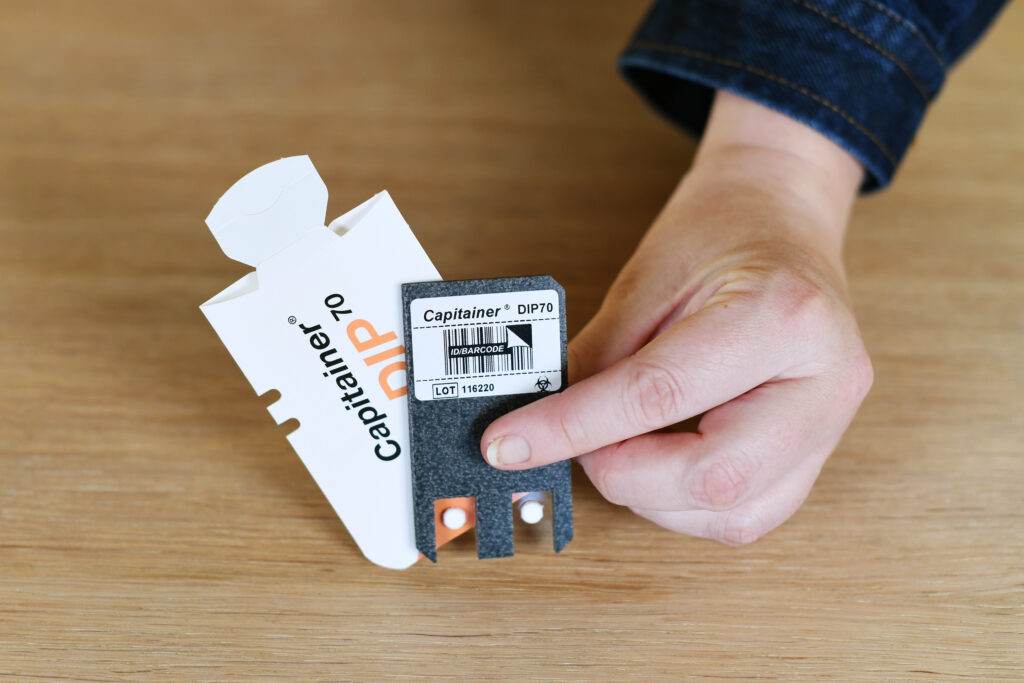
With Capitainer®DIP70, the sample is dried after collection, removing the need to transport liquid.
This enables a more practical format for transport and handling, without changing how the sample is used in the lab.
- Stable during transport
- Can be shipped with standard mail
- No need to handle liquid samples
👉 Read more about Capitainer®DIP70 here.
📍 Upcoming events
SFKK May 6-8
Johan Olausson, Mikael Ström and Mathias Karlsson from Capitainer will be attending SFKK, where they look forward to connecting with colleagues within clinical chemistry and discussing ongoing developments in microsampling.
Vitalis May 4-7
Our CEO Christopher Aulin will be present at Vitalis together with our partner Strålfors [booth B11:44], where we will highlight our joint approach to enabling scalable solutions for self-sampling and decentralized care.
If you are attending either event, feel free to stop by and meet the team!